
The IWSA has held the Winter Swimming World Championships every two years since 2000. Over time, the championships have become a truly global event, attracting swimmers from every continent. Nearly two thousand swimmers entered this year’s edition.
This year’s host was Oulu in Finland, also a European Capital of Culture for 2026. Thanks to winter swimmers, it became the world’s cold-water swimming capital too! It was the Finns who established the world championships tradition. That is hardly surprising: the Finnish philosophy of life known as sisu means facing difficult challenges, including plunges into icy water, with stoic determination.
Twenty-four swimmers from our club travelled to Oulu for the IWSA World Championships. We brought an excellent, eager team, and some of us even had medals in our sights! Our I. PKO delegation was international: club members come not only from Czechia but also from Great Britain and Belgium. We even have an American winter swimming world record holder, Scott Lautman, whose ancestors came from the Czech lands. Scott joined the club two years ago, when he swam the North Channel with our Czech Youngsters 60+ relay team.
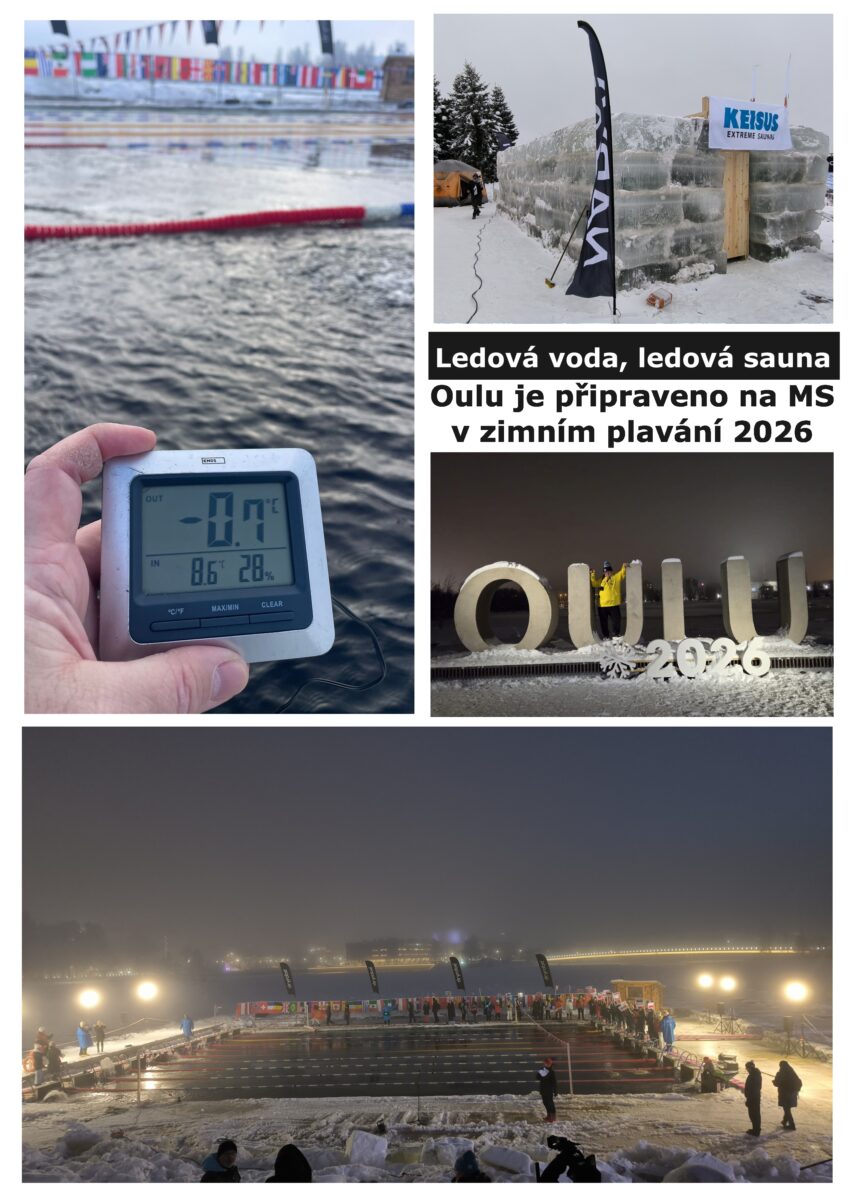
The championships opened with a ceremony beside the outdoor pool on the evening of 2 March 2026. The welcoming speeches included the winter swimming community’s credo: ‘No water is too cold when the spirit is strong.’ And it certainly needed to be strong: a tough test awaited us, with the water temperature dropping to −0.7°C! The championship venue is on an island in a sea bay at the mouth of the Oulujoki River, which explains how the water temperature can fall below zero.
There are ten individual events: 25 m butterfly; 25, 50, 100 and 200 m breaststroke; and 25, 50, 100, 200 and 450 m freestyle, plus relays. Swimmers compete in five-year age groups from 20 to 90, as well as junior categories. The ten-lane, 25-metre pool, open to the sea underneath, had been set into a hole cut in the ice, with illuminated underwater lane lines. The organisers had placed various types of sauna around the pool for the swimmers. Particularly striking were an extreme sauna with walls made of ice blocks and saunas inside yurts. From 3 to 7 March, every swimmer’s adrenaline surged before each race as the familiar commands rang out: ‘Take off your clothes — Get into the water — On your marks — Start!’
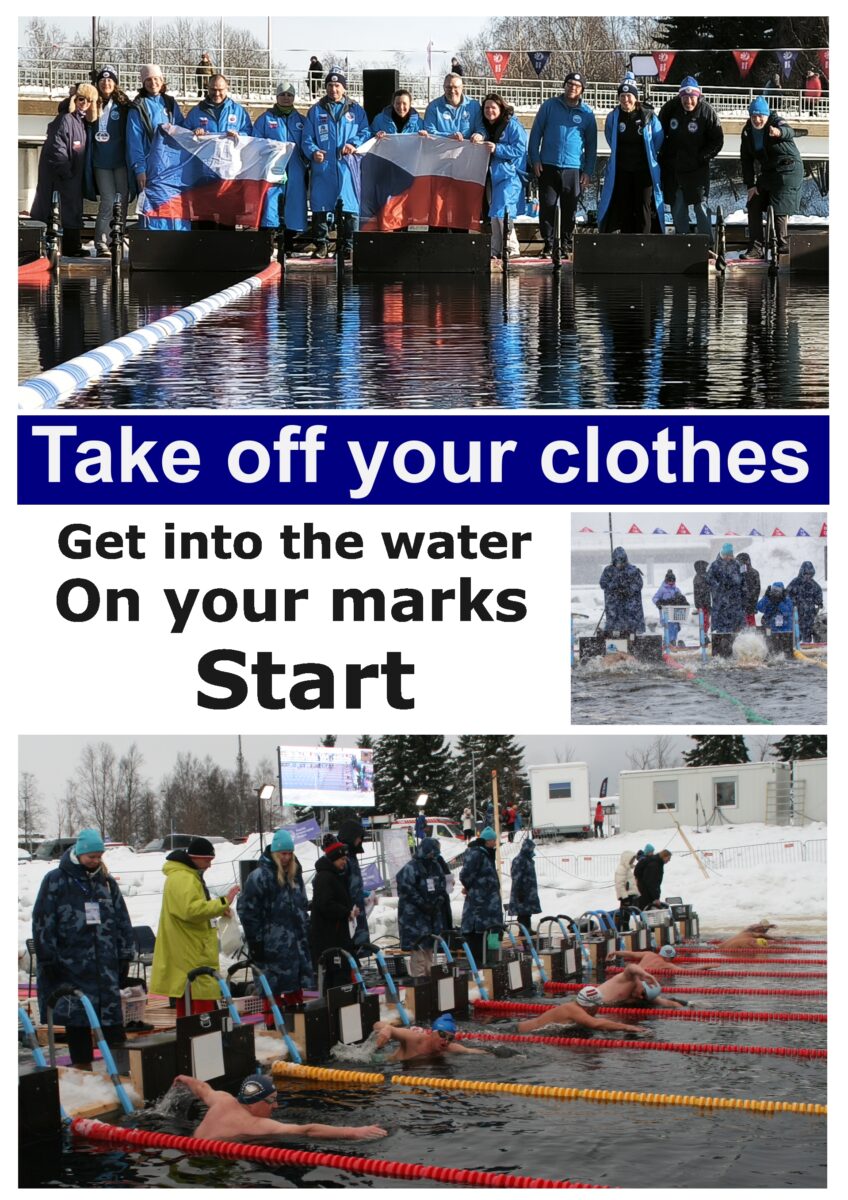
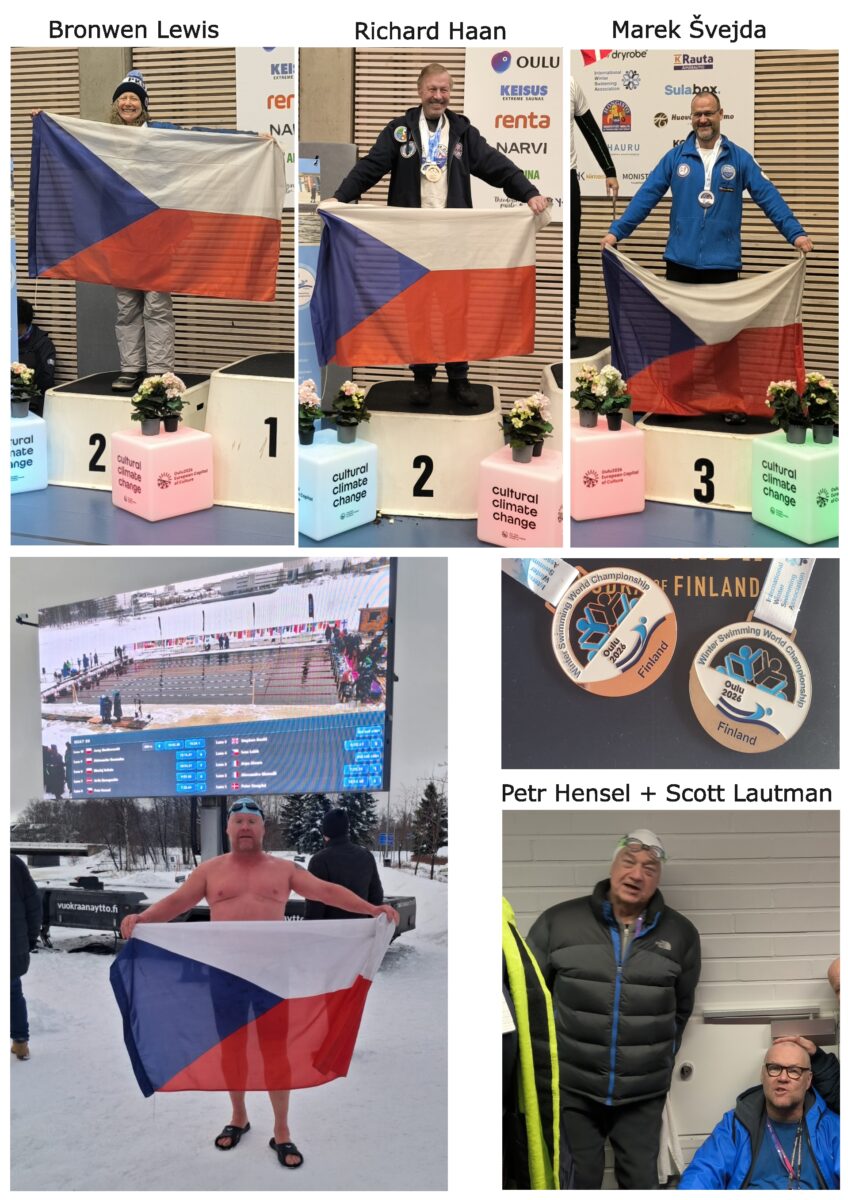
As tradition dictates, the opening day, 3 March, began with butterfly. The 100 m breaststroke followed, and then came a severe test: the 200 m freestyle, held towards evening as the cold intensified. Ice slush was forming around the pool’s edges faster than the organisers could clear it. This made it difficult for swimmers to find their bearings, especially at the turns. Many suffered cuts from the ice, and after dark there were even dangerous collisions with the plywood walls at the ends of the pool. Yet it was in these extreme conditions that our swimmers claimed their first medals: Richard Haan, Marek Švejda, Bronwen Lewis and Scott Lautman.
Nerves were mounting before the next races. Day two brought the blue-riband event: 450 m freestyle, or 18 lengths! At the mandatory medical check before this distance, staff recorded extraordinarily high blood pressure readings, and many swimmers had to be checked several times. For safety, every swimmer in this event needed their own poolside companion, or ‘buddy’. All eleven of our men and women entered in the 450 m completed the distance successfully. Petr Hensel even won bronze in his age group!
We could now count our swimmers’ age-group medals:
Richard Haan: bronze in 100 m breaststroke and silver in 200 m freestyle.
Bronwen Lewis: silver in 200 m freestyle and bronze in 100 m freestyle.
Marek Švejda: bronze in 100 m breaststroke.
Petr Hensel: bronze in 450 m freestyle.
Scott Lautman: silver in 25 m butterfly, gold in 50 m freestyle, silver in 25 m freestyle, bronze in 50 m breaststroke and gold in 100 m freestyle.
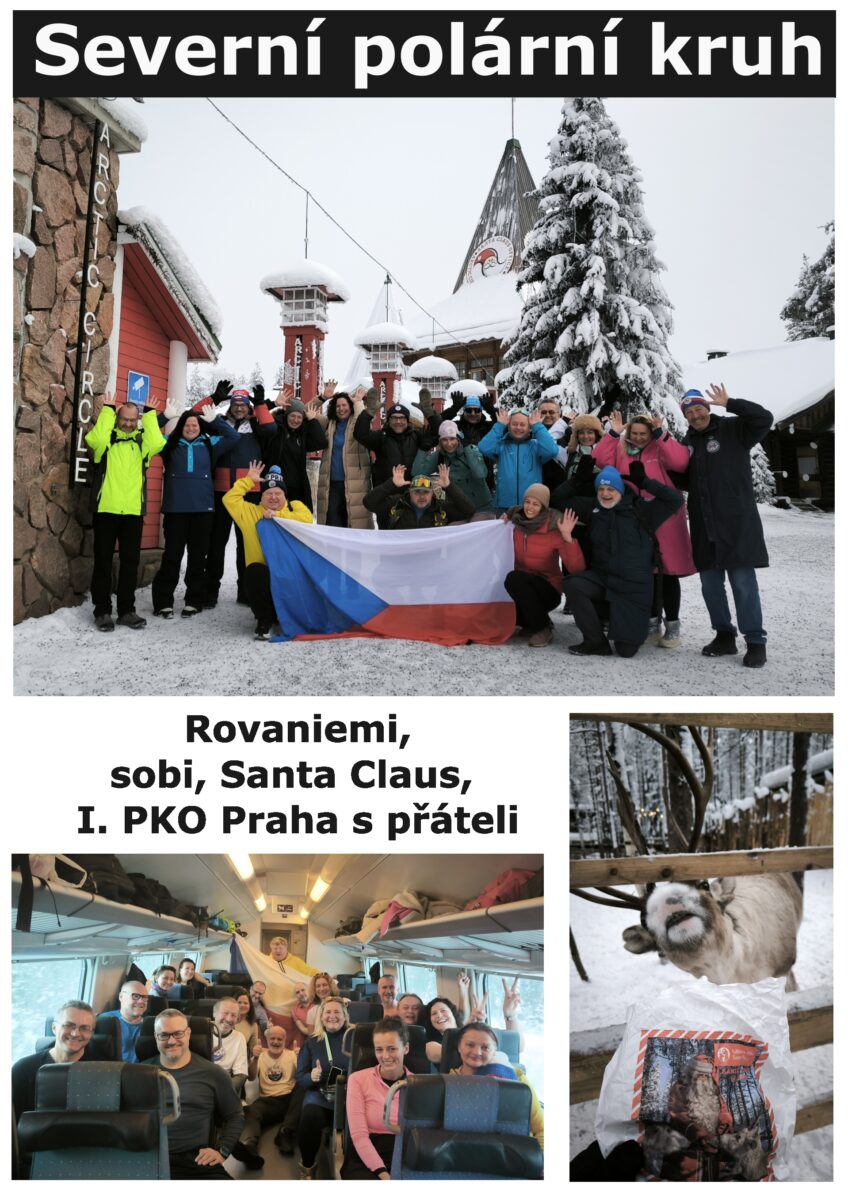
We had the third day off, and most of us took a train to Rovaniemi on the Arctic Circle. At Santa Claus Village, some enjoyed a dog-sled ride, others fed the reindeer with lichen bought there, and all of us savoured the wonderful feeling of being together so far north!
The individual races in Oulu ended on day four with the 100 m freestyle. Besides I. PKO Praha, six other Czech clubs from the Czech Winter Swimming Cup competed: Fides Brno, KLM Třebíč, OPp České Budějovice, PK Krupka, SO Hradec Králové and PK Havířov. The Czech Cup races had prepared us all well. Among the younger Czech swimmers, Jakub Bojceňuk of Havířov won the junior 100 m breaststroke. Our own Kuba Kačerovský was absent, as he was in New Zealand training for a Cook Strait crossing. Czech swimmers also excelled in the older, more experienced age groups: Bedřich Hanuš and Petr Mihola each won two golds, and Vlaďka Fialová won one, all for Fides Brno. The Brno swimmers also added three silvers and three bronzes. It was a shame for I. PKO that Ríša Haan could not swim the 450 m, where he had a strong chance of winning his category. Before the entry deadline, the IWSA unexpectedly closed entries because too many swimmers had already signed up, so he was unable to enter. I will return below to a major Czech success in the overall women’s IWSA World Cup standings: it was contested right up to the final race in Oulu, and the results were only announced at the closing gala.
Tomáš Prokop, our I. PKO chairman and head of the Czech Swimming Federation’s winter swimming section, watched our swimmers’ efforts with satisfaction and enjoyed racing himself. In the evening we celebrated at the campsite by the lighthouse. Those patient enough to stay up after midnight were rewarded with the northern lights! This breathtaking natural spectacle provided celebratory ‘fireworks’ for everyone at the championships.
IWSA championships have much in common with masters events: apart from the 50-metre sprint super finals, medals are awarded only within age groups, rather than for overall placings. Perhaps that helps explain the friendly atmosphere, with many swimmers coming primarily to enjoy the races. Even so, there were outstanding, world-class performances. Italy’s Jegor Tropeano swam the 100 m breaststroke in 1:08.81. I watched, holding my breath: he looked as though an invisible winch were pulling him through the water. For comparison, a similar time won the breaststroke at the 1968 Mexico Olympics. At its highest level, winter swimming now produces results comparable with those achieved in warm water almost sixty years ago.
The sea around Oulu was still frozen. You could walk or cross-country ski for kilometres away from the shore, and the ice was still about a metre thick. I checked with a ski pole where anglers had drilled through it with enormous augers. After dark, each night you could also watch the lights of an icebreaker opening up the only shipping route into Oulu harbour.
Before the championships, the women in our club looked up some useful Finnish phrases. One essential seemed to be ‘minulla on kylmä’ — ‘I am cold’ — remembered through a playful Czech phrase that sounds rather like it, ‘minula mě kulma’. In the end it really was cold, but belonging to the worldwide winter swimming community kept our hearts warm!
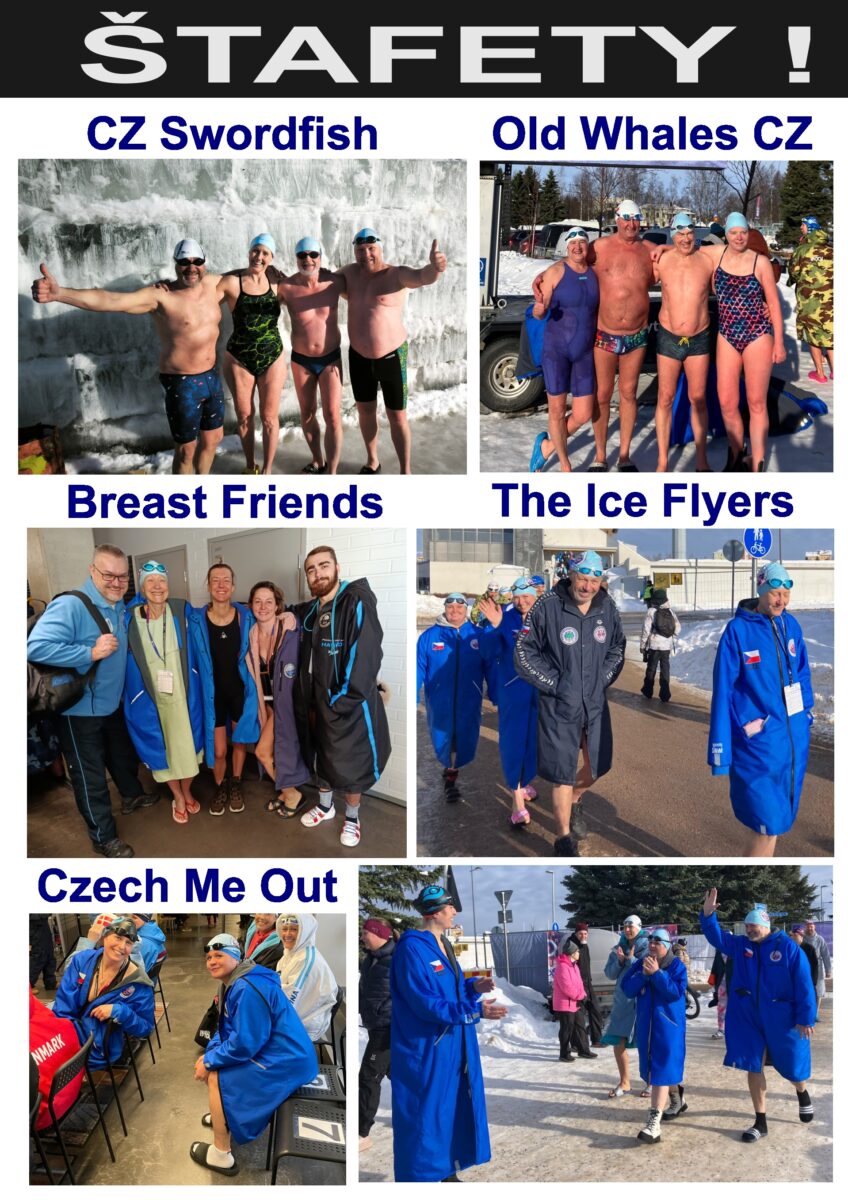
The sporting programme traditionally ends on Saturday with mixed 4 × 25 m breaststroke and freestyle relays. By then the mood was relaxed, and we enjoyed cheering our friends on through their final swims in the pool. These were our relay teams, made up of I. PKO members with help from swimmers from friendly clubs:
Stay Abreast (Zuzana Skálová, Josephine Polak, Kamila Šindelářová, Richard Haan); Breast Friends (Zuzana Štrachová, Barbora Ghandi, Bronwen Lewis, Jakub Bojceňuk); Old Whales Czech Republic (Zuzana Pátková, Bernard Nizet, Libuše Švrčková, Jaroslav Zeman); The Ice Flyers (Kamila Šindelářová, Bronwen Lewis, Zuzana Skálová, Richard Haan); Czech me out! (Lenka Škvorová, Eva Petana, Jana Švadlenová, Tomáš Prokop); CZ Swordfish (Petr Hensel, Trisha Elmer, Ivan Lalák, Marek Švejda); and Team Lautman (bronze in the 4 × 25 m freestyle).
After the relays came artistic swimming routines performed by teams of winter swimmers. When swimmers dressed as little fish marched to the pool to Edvard Grieg’s March of the Dwarfs and leapt spectacularly into the water, many of us thought: this is what pure joy in life looks like.
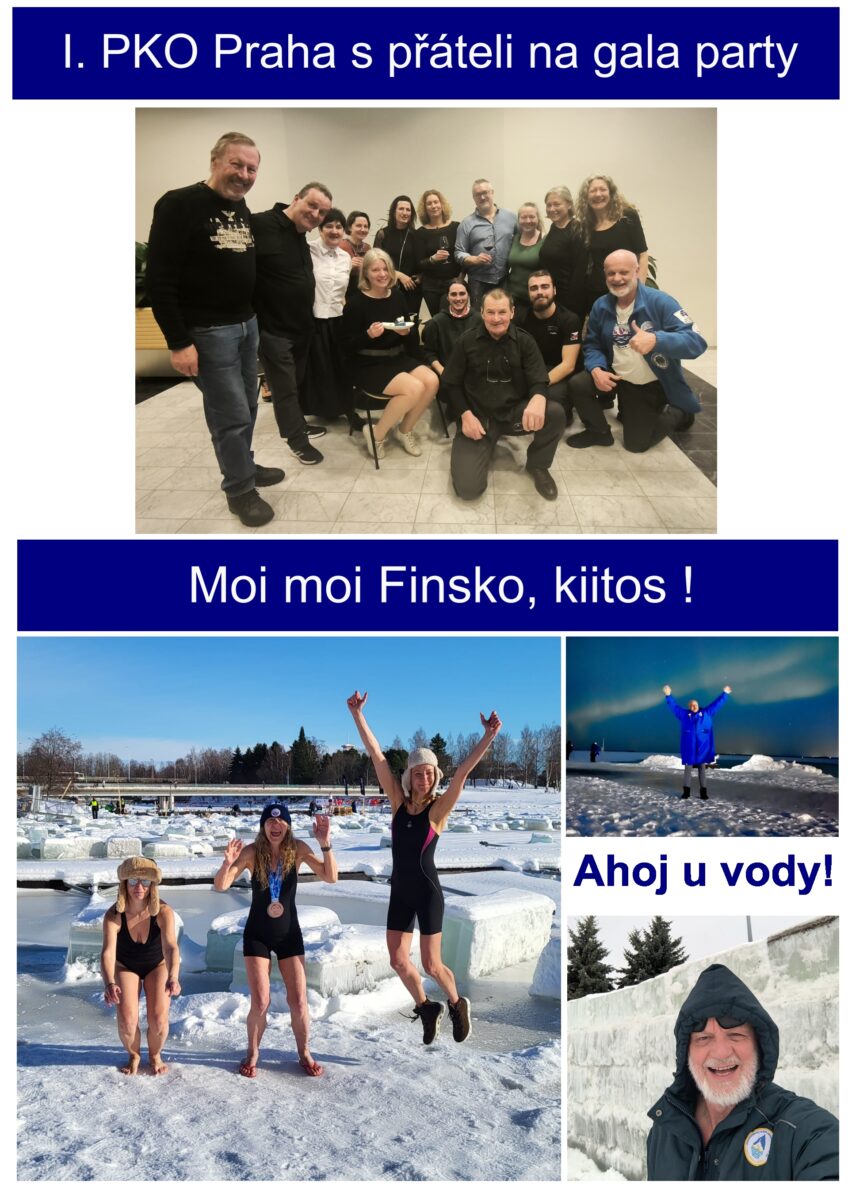
On the final evening, the closing gala was held in the city’s concert hall. We were delighted to watch Andrea Klementová of Třebíč receive her award for third place in the overall women’s IWSA World Cup standings for the 2025/2026 season. It was an outstanding achievement for Czech winter swimming.
Then it was time simply to socialise. Before the final dance with a live band, Oulu’s mayor gave a speech promising that they would look after the snow and ice up north for winter swimmers, and that we would always have somewhere to return to! At the very end, the hosts of the next IWSA World Championships were introduced.
The 2028 event will take place in the Southern Hemisphere, in Argentine Patagonia, and tango dancers ran onto the stage. So, see you by the water — and perhaps in two years’ time among the penguins in the sea, far south in Argentina.
Written by Ivan ‘Mečoun’ Lalák, March 2026
Photos: Ivan Lalák and members of I. PKO