
It is with great sadness that I write these lines to tell cold-water swimmers, long-distance swimmers and friends of both sports that our long-serving sports commentator and honorary member of I. plavecký klub otužilců Praha, Vladimír Kulíček, has left us forever. I had known him for more than forty years. For me, as for everyone who knew him, this was very sad news.
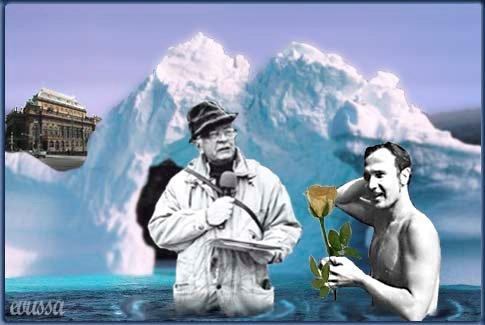
On my earlier visits to Prague we always met many times, and always had something to talk about, including everything we had experienced together over those forty years. I treasure those memories and certainly always will. Nor will I forget our very last meeting, more than three years ago, when Vladimír said goodbye to me in person: we both knew we were seeing each other for the final time. From then on, however, we spoke by telephone for thirty minutes every Friday, and always had something to discuss. We shared interests, including long-distance swimming and cold-water swimming.
For readers who did not know Vladimír, I would like to tell you a little more about him.
Vladimír Kulíček was born in Prague 84 years ago, studied mechanical engineering and devoted most of his working life to the research and development of industrial and long-distance networks and their equipment. As well as hiking and swimming throughout his life, he worked closely and tirelessly with leading Czech cold-water swimmers for more than half a century. In recent years, long retired, he devoted himself to writing columns and short stories published in outlets including Australia’s Spektrum, Pozitivní noviny, CzechFolks.com Plus, Český dialog, SeniorTip and others. His writing grew from his exceptional gift for observing the world and everything around us, together with the considerable storytelling humour that never left him.
I first met Vladimír Kulíček in autumn 1970 at the First Cold-Water and Endurance Swimming Section of TJ Praha-Hostivař. By then he had been active in its organisation for 22 years, as adviser and right-hand man to Oldřich Liška, the elder statesman of Czechoslovak cold-water swimming well known to the sporting public (http://www.pozitivni-noviny.cz/cz/clanek-2008030003, http://www.pozitivni-noviny.cz/cz/clanek-2009020017). Within a few years he became a familiar radio and television commentator for winter swimmers’ sporting appearances, a role he continued, with only a few breaks, for 52 years: a truly impressive span.
Everyone who knew Vladimír will confirm that he remained young in spirit, with a strong sense of fairness and justice. He would have turned 85 on 20 December this year.
To give readers a fuller picture of this wonderful man (http://www.pozitivni-noviny.cz/cz/clanek-2008050072), I will end my sad recollections with a cheerful memory I once wrote about him. Knowing Vladimír, I am sure that is what he would have wanted.
Finally, I would like to express my deep and sincere condolences to Mrs Světla Kulíčková, all his surviving family and his friends.
Václav Židek
************************
A conversation with a “daft old man”
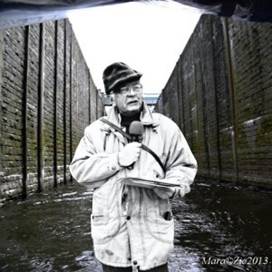 Long ago, many, many years back, I was travelling on a city bus with my sporting friend Vladimír. Until quite recently, when I visited Prague several times a year from my home in Cologne, we always enjoyed meeting and remembering the golden days of our youth — latterly, preferably over a good Gambrinus beer at U Fífy in Vinohrady.
We have known each other for over forty years, so we know a good deal about one another. Vladimír accompanied me as cameraman and photographer on my unusual non-stop 33-kilometre swim from Slapy to Prague, through the navigation locks. A year later we repeated the swim, extended to forty kilometres, with František Venclovský, then the first Czechoslovak to have conquered the English Channel. Those swims became the book Sám ve víru zdymadel — “Alone in the Whirl of the Locks” — in which Vladimír also played a major part. At other times his voice could be heard over the loudspeakers at the Alfred Nikodem Memorial beside Prague’s National Theatre, or as a television co-commentator at sporting displays and competitions.
Our bus was approaching Vladimír’s stop, so he got ready by the front doors. I was continuing farther. The driver said something, but the engine noise as the bus slowed made it inaudible. The bus stopped and the engine almost fell silent, yet the doors did not open. The driver spoke again: “Didn’t you understand what I said?”
At that moment, a much older memory flashed through my mind: something Vladimír had experienced more than 65 years earlier. I realised I might be about to witness a miniature comedy of manners, played out not on a stage but in real life. I had good reason.
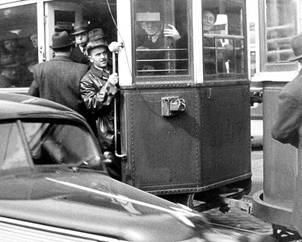 Back then, during the Protectorate of Bohemia and Moravia, Vladimír was returning home by tram. It was December, freezing, and little could be seen in the early evening darkness. Blackout regulations against Allied bombing meant even the street lamps glimmered less brightly than a cemetery on All Souls’ Day. Darkened, open-platform, overcrowded trams crawled through the city.
Passengers even clung to the boarding rails. The driver stood on the open platform at his controller, hemmed in, buffeted and jostled by passengers. It was hard work, and even his heavy tram driver’s coat and felt boots barely kept out the frost. Still a young man, Vladimír was pushed against the driver by the crowd. The driver was very grumpy and probably felt he could take liberties with a youngster: “What are you gawping at? Move inside and stop pushing!”
My friend decided there was no point arguing with a lout. With his one free hand, he simply gestured that he would gladly move farther in if he could.
“What did I say? Are you moving, or do I have to help you?” Another similar gesture followed. And then it happened. The atmosphere of the Protectorate, with its many threats, had drawn Czechs together in solidarity and mutual help wherever possible. The passengers assumed from the gestures that Vladimír was deaf and unable to speak, and gave the driver a thorough dressing-down. What a brute! If he had the young man’s disability, he would know what hardship meant. He should shut up and get on with driving.
The driver was stunned. Without another word, he continued. Stops and passengers fell away, and by the time Vladimír’s stop approached, the platform was almost empty.
The tram halted. My sporting friend leaned towards the driver, thanked him for the pleasant journey and stepped off. The astonished driver remained on the platform for a moment, taking in this new turn of events before continuing.
Remembering all this, I was naturally curious to see how the conversation with our bus driver would develop. After the driver’s opening remark, Vladimír turned slowly, as though with difficulty, and spoke very slowly and clearly:
“Do forgive me, driver. I didn’t quite understand. I’m a little hard of hearing, you know — my age!” The driver visibly softened and continued much more gently, but louder, unconsciously imitating my friend’s slow, distinct pronunciation: “Oh, I only said you mustn’t step over the white line on the floor before the bus stops, so I can see out!”
My friend’s face showed only a faint grasp of this explanation. “I seem to have broken some rule, haven’t I? Do forgive me, driver, if you can!”
“Oh, nothing’s happened, really!” replied the driver, plainly trying to end the conversation, and opened the doors. But my friend turned back to him: “What did you say, please, driver?”
“THAT NOTHING’S HAPPENED!” the driver roared at the top of his voice, practically to the whole bus. Passengers at the back, unaware of what was going on, rose in alarm; those at the front burst out laughing.
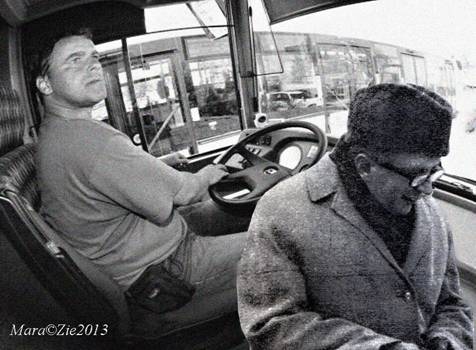
A friendly smile and a look of understanding spread over my friend’s face:
“Oh, I see, nothing’s happened — I’m very glad! It would be dreadful if there were an accident, perhaps even through my fault. Thank you very much, driver!”
He turned with dignity and got off. The bus slowly moved away. Up front everyone was cheerful, and the smiling driver shook his head incredulously over the steering wheel.
I tried to imagine what he might be thinking: “Why didn’t I keep my mouth shut? I could have spared myself that ridiculous conversation with a DAFT OLD MAN who doesn’t understand a thing and is deaf as a post!”
This really happened. The man who staged it was none other than the popular sports commentator known to cold-water swimmers, Vladimír Kulíček: eyewitness to history and practical joker in one. His relatively youthful appearance contrasts sharply with his completely grey hair, making his fairly advanced age difficult to guess. That contrast can give rise to amusing situations which Vladimír, when the occasion calls for it, can create with his own distinctive sense of humour.
Václav Židek
************************
Articles by Vladimír Kulíček:
http://www.pozitivni-noviny.cz/cz/clanky-autora-84
http://czechfolks.com/plus/category/autori/vladimir-kulicek/